
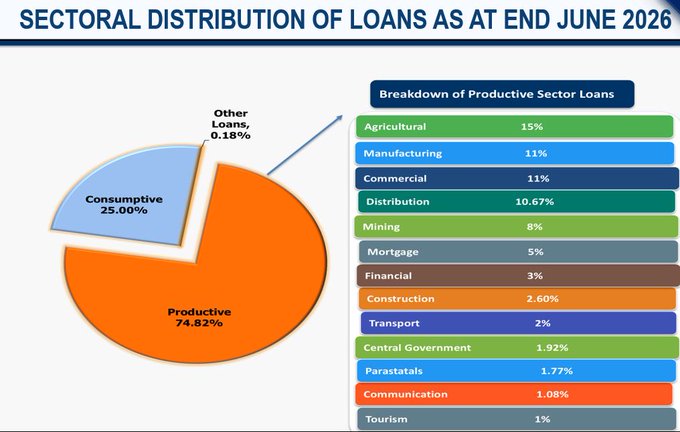
Zimbabwe’s banking sector has defied persistent economic headwinds to post a robust lending surge in the first half of 2026, with total loans and advances hitting ZiG85 billion, even as non-performing loans (NPLs) remain well below global danger thresholds a signal of underlying stability in a currency environment often dogged by volatility.
The latest sector performance update, covering the period ending June 2026, reveals a banking system that is not only growing its balance sheet but also prioritizing productive enterprise.
A striking 74.8% of all credit extended has been channelled into agriculture, mining, manufacturing, and other cornerstone industries a deliberate shift away from speculative financing that has haunted the sector in past decades.
However, the most telling figure is the currency composition of that lending.
Foreign currency-denominated loans accounted for a staggering 90% of total advances, underscoring the market’s unyielding preference for United States dollar financing amid lingering uncertainty over the local unit’s long-term purchasing power.
This dollarisation of credit mirrors the broader economy, where parallel-market pressures continue to shape everyday transactions.
On the asset-quality front, the sector appears to be on solid footing.
The non-performing loan ratio was recorded at 3.6% as of mid-year comfortably below the internationally accepted 5% benchmark.
That cushion gives regulators room to breathe, even as global financial conditions tighten.
Deposit mobilization also told a story of cautious optimism.
Total banking sector deposits climbed to ZiG148.1 billion by end-June, with foreign currency deposits making up 80% of that total.
The heavy skew toward dollar-denominated savings suggests that corporates and individuals alike are still hedging against local-currency erosion, despite official efforts to stabilize the ZiG.
Yet not all indicators pointed upward.
Profitability took a noticeable hit, with the sector posting an aggregate net profit of ZiG1.5 billion for the quarter ended 31 March 2026 a sharp drop from the ZiG2.6 billion recorded in the same period of 2025.
That 42% year-on-year decline raises questions about margin compression and operating costs in a high-inflation environment.
According to the official report, earnings were chiefly driven by fee and commission income, which supplied 47.5% of total income, while traditional interest income from loans contributed 40.9%.
That mix reveals a sector increasingly reliant on transaction-based revenue rather than net interest margins a trend that could expose banks to volume shocks.
Nevertheless, the broader picture remains one of resilience.
Regulators noted that the banking system continues to be both adequately capitalised and highly liquid, with loan-to-deposit ratios staying within prudent ranges.
Banking sector analysts who spoke to this publication described the figures as “a mixed bag but fundamentally sound.”
One Harare-based economist, who asked not to be named, observed: “The 3.6% NPL ratio is the real headline here. In a market where many businesses are struggling to service debt, that number shows disciplined underwriting. But the profit slump cannot be ignored it signals that banks are earning less from lending and more from fees, which is not sustainable over the long haul.”
Another senior banking executive remarked: “We are directing the lion’s share of credit to productive sectors, which is exactly what the economy needs. However, the 90% dollar-lending share is a reality check. Until we restore genuine confidence in the ZiG as a store of value, that ratio won’t shift meaningfully.”
The data ultimately paints a picture of a banking sector that is resilient but not immune growing its loan book, protecting asset quality, and funding real-economy projects, yet grappling with shrinking profits and an undeniable currency bias that continues to define Zimbabwe’s financial landscape.
For now, the sector stands as a guarded bright spot, but sustainability will depend on broader macroeconomic reforms that go beyond the balance sheet.


0 Comments