
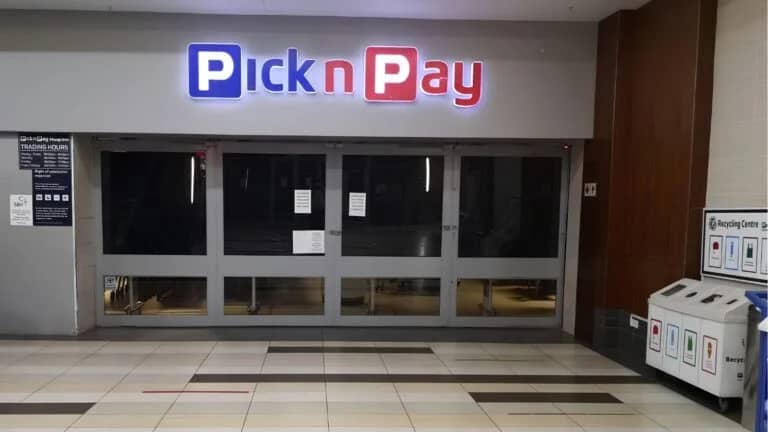
Pick n Pay has shut down 56 stores across South Africa during its 2026 financial year as part of a major restructuring programme aimed at restoring profitability, the retailer said as it released its full-year results.
The closures, which spanned the group’s supermarket, hypermarket, liquor and clothing divisions, form the centrepiece of a reset strategy that CEO Sean Summers said was now “effectively behind us.”
While the company reported a wider trading loss in its core Pick n Pay segment, it pointed to improving like-for-like sales and strong growth from its Boxer brand as evidence that the turnaround was gaining traction.
Group turnover rose 3.4% in the 52 weeks to 1 March 2026, driven largely by Boxer, which recorded growth of 12.3%.
However, turnover in the core Pick n Pay business declined by 1.6%, which the company attributed directly to the closure of dozens of stores.
The biggest reduction came in the franchised business, where the supermarket footprint shrank from 260 stores in 2025 to 211 in 2026.
The retailer also closed 29 franchised liquor stores during the year under review.
Overall, company-owned stores increased from 971 to 992, but franchised stores declined from 697 to 620 resulting in a net closure of 56 stores nationwide.
Despite the cuts, Summers stressed that the business was on a firmer footing.
“While Pick n Pay’s FY26 trading loss increased, the business today is fundamentally stronger than it was two-and-a-half years ago as a result of the action we have taken and the investments we have made,” he said.
The CEO added that difficult decisions had been necessary, including a formal Section 189 consultation process to reduce labour costs.
“Without this recalibration, we cannot solve the Group’s cost base or return the business to profitability in a thin-margin industry,” Summers said.
He emphasised that the process was aimed at long-term sustainability rather than simply cutting jobs, adding, “The challenges facing Pick n Pay developed over an extended period.
This means that rebuilding the business into a leading supermarket retailer again will take time, disciplined execution and difficult but necessary decisions.”
There were some positive indicators.
Company-owned supermarkets recorded like-for-like sales growth of 3.9%, up from 3.3% in the previous financial year.
Pick n Pay kept internal selling price inflation at 1.9%, well below South Africa’s food inflation rate of 4.4%.
Its online business performed strongly, with turnover increasing by 32.7%, while the group’s gross profit margin improved by 0.5 percentage points to 18.8%.
Summers said customer feedback was encouraging.
“Our store estate reset is effectively behind us, and we have achieved some of the key milestones we set ourselves in our strategy. The positive customer feedback that we are getting is really very encouraging,” he said.
The group’s trading profit fell 4.2% to R1.7 billion, reflecting a R330 million increase in Boxer’s trading profit to R2.6 billion, alongside a R404 million widening of Pick n Pay’s trading loss to R1 billion.
Still, the group reduced its headline loss by R45 million to R363 million.
A R4.7 billion Boxer share placement completed in May 2026 has strengthened the company’s balance sheet, Pick n Pay said, and will support continued investment in the turnaround.

0 Comments